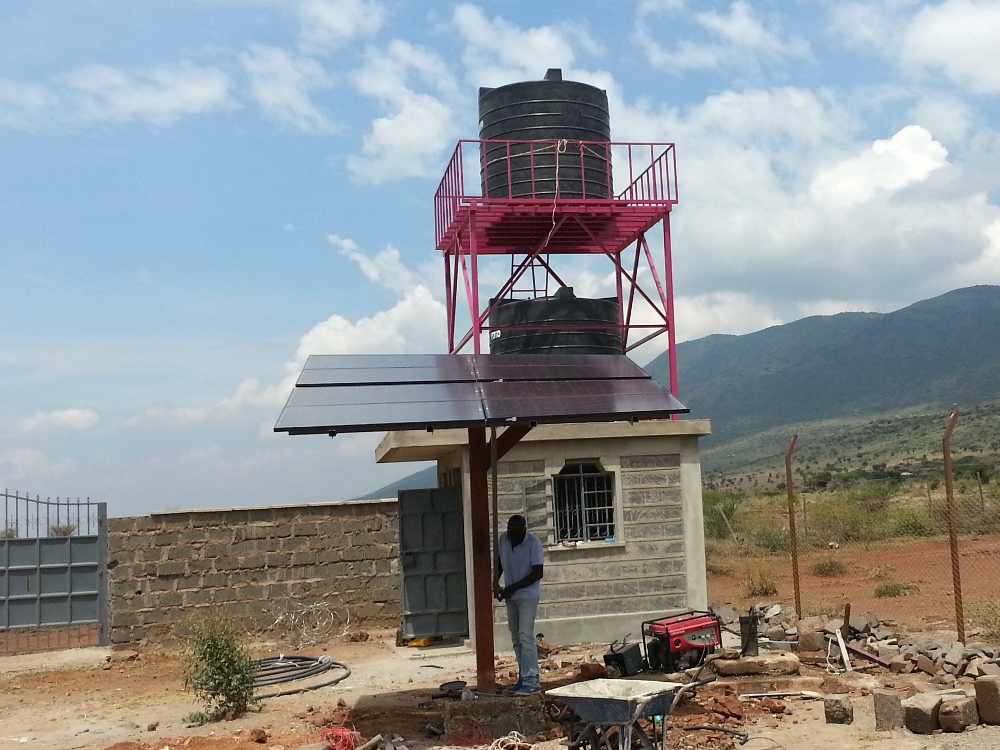
Drilling
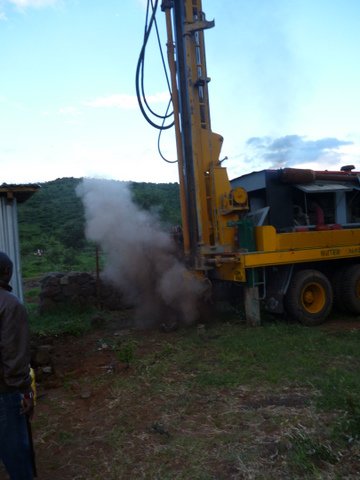
A drilling rig is required for the drilling. As the drill progresses into the ground, extra drill rods are added until eventually the drill reaches the required depth; 160m (500') in our case. We employed a geologist to supervise the drilling process; one of the best decisions we made. Once drilled, the bore-hole must be lined with steel casing to stop the bore-hole collapsing and to screen out the large sand particles from entering the pump. The casing is plain in the areas with no water and with fine slots in areas with water. The drillers were unable to force the casing into the bore-hole because the bore-hole had not been drilled straight. They tried to pretend that all the casings were inserted but the supervisor found the casings hidden in the back of the lorry.
The only solution was to drill a second (straighter) bore-hole. This was done, then after many days of extra work, the casing was inserted correctly. Between the casing and the bore-hole, a gravel filter pack is added. This helps to keep the sand away from the pump and filters the water. The drillers tried to pretend that they had fitted all the filter pack, whereas they had fitted very little. Once again, the supervisor spotted this and corrected the situation.
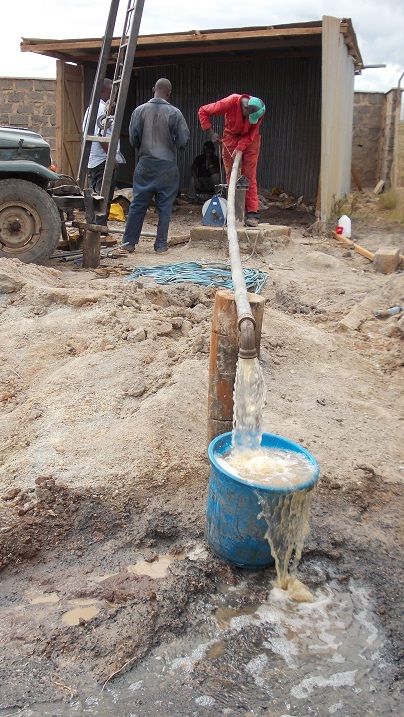
During drilling, the water layers tend to get blocked by clay and other debris from the drilling. For maximum water yield, the bore-hole must be developed. High pressure water and air are forced down the bore-hole to open up the pores. After development the bore-hole is given a 24hr test pump to pump out dirty water and to check what yield the bore-hole can supply. In our case, the bore-hole is able to supply 2,800L / hour. Finally, samples are taken for bacteria and chemical analysis. Our water is clean with a slightly elevated level of floride (1.55mg/L at our bore-hole verses a WHO recommendation of 1.5mg/L or a USA EPL safe limit of 4mg/L), but still deemed fine for drinking by the testing laboratory.
Test pumping to check flow rates